 03:52

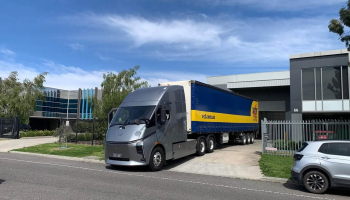


Deepway Star semi trailer from China joins the growing number of trucking brands on Australian roads. Information was shared over LinkedIn, Facebook, and through phone interview.
Deepway delivers a load. Photo courtesy Mark Blackburn.Mark Blackburn, Managing Director of VCF Transport Services, is not only proud of the newest acquisition to their logistics fleet, but also keen to share the advantages of running an all-electric semi. On both Facebook and LinkedIn, he is sharing real-life facts with enthusiasm. Real freight, real routes, real-world results, he proclaims.
We welcome the Deepway Star to Australian roads. It looks like every few months there is a new electric semi to look out for. Check out this piece, for example.
“Deepway is a Chinese technology company specialising in new-energy heavy-duty trucks and intelligent road-freight solutions. Its goal is to move road freight toward zero-carbon, efficient and safe logistics.” Launched in 2020, orders for the Deepway Star now exceed 5000 globally. The Deepway Star is designed as electric from the ground up and is touted as being suitable for bulk haulage. Its 600 kWh LFP CATL battery can provide a 300–500 km range.
The truck was “Co-designed with Pininfarina, featuring a torpedo-style front nose and a low drag coefficient of just 0.35 Cd.” One of his commentators on Facebook still said they preferred the look of the old diesel trucks! No accounting for taste. The Deepway is built with “advanced smart driving architecture, integrating Baidu’s autonomous driving tech roadmap.” All in a cool looking truck.
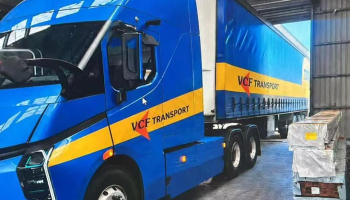 Real loads, real facts. Deepway semi. Photo courtesy Mark Blackburn.
Let’s get back to Mark and what is actually taking place in his Victorian family-owned haulage business. Last week he posted on Facebook:
“Our Deepway semi, collecting the day’s 25t load of cement from West Footscray, for distribution at our Dandenong South and Wonthaggi depots. It’s happening, no grants, no trials, just common sense.” Mark says that the business plan is not only to use these trucks for the entire operation. They have also become a distributor of the vehicles, “so we can try to enable more businesses to make that change. Deepway is $350,000, as opposed to some of the competition that start at $700 and go to $1.1m. These are vehicles designed from the battery up, and priced to help us smaller operators make that change.” Now, that’s commitment and also ambition.
Over 200 comments were made, most of them questions and 99% of them positive, some even from experienced heavy vehicle drivers. Mark was very generous with his information. Below are some of the relevant comments: Mark told his Facebook followers that his Deepway uses about 35% of a charge on a 150 km run carrying 20 tons. This included time idling on the freeway not producing pollution — “ICEs are incredibly wasteful and polluting when standing idle.” One commentator attempted sarcasm, and an amusing conversation ensued. “But, but, but it’s no good for the Nullarbor when you are hauling 100 ton.” “There are other electric trucks for that…” “that’s not the target market,” “and it’s not where most trucks are operating either. Most trucks travel Brisbane, Sydney, Melbourne, and across to Adelaide.” “Sarcasm isn’t easy online.” Here is a little more: “Neither is your 4 x 4 Towing 12 ton. Or your pushbike towing a 6 x 4 trailer as they are not made for it.”
Asked about energy efficiency, Mark replied that energy consumption ranges from 121 to 160 kWh per 10 km driven. The information is available through instrument cluster on the dash. “Pretty decent for a truck with a 20 ton load,” was the response. Mark adds that the VCF’s Deepway Star is only used for 150–250 km trips, so “we don’t need to push that envelope.” Mark tells his readers that they take 3–4 hours to charge the truck.
One reader worries about long trips with perishable goods, but Mark counters with the fact that VCF doesn’t do runs like that. Currently, only 11% of Australia’s road freight travels more than 300 km a day. Even if they have to stick with diesel for now, it still leaves 89% (by far the vast majority) that can transition across to EV — the right (and least dangerous) tool for the job. You don’t use a hammer to drive in a screw.
Another reader enthuses about the transition: “This is the future of trucking. This will change how freight is moved. This is a big step since freight went from a horse and cart to the ICE. However, the biggest change will be electric driverless trucks, and that is coming sooner rather than later.”
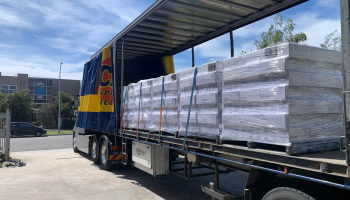 Deepway delivers the Etch. Photo courtesy Mark Blackburn
On a recent run, Mark tells us that VCF collected “around 20t of Etch drinks (they are a delicious non-alcoholic sparkling drink!) from CCF and ran them back to our depot. Total trip was 152 km, and the truck started at 70% and we finished at 30%. And moreover, we did not harm any diesel during the filming of this run.”
Mark very graciously gave me some time as he was driving back to the depot (in his diesel ute — he bought it just before the BYD Shark 6 came out). Over the phone, he answered my questions. I asked how he obtained his Deepway Star. He said there was one parked near his depot in Dandenong, and after many enquiries, he found out what it was and ordered his first. One is working already, another is on the water (in a ship), and he is considering a third. That will replace his whole diesel fleet.
Once the finer details are worked out, Mark intends to offer discounts to his customers equivalent to his savings on fuel. That should make the competition sit up and take notice. Mark set out to go electric, as it is better for the planet. He found it hard to buy a truck that “did what it said on the tin.” This only works if we all talk facts. Mark is providing those facts from real-world experience.
Deepway promises 350–400 km of range and the ability to carry a load up to 49 tons. All of this for AU$350,000. So far, he is more than satisfied with the truck’s performance. I asked if he was getting support from ARENA or any other government agency. “I applied for a Victorian government decarbonisation grant, but was not successful.” He is now approaching ARENA for funding to install charging infrastructure at this depot. “It would make sense and save time if we could charge while loading/unloading or overnight. Charge when the wheels aren’t turning,” he told me. At the moment, he has to take the truck offsite to charge.
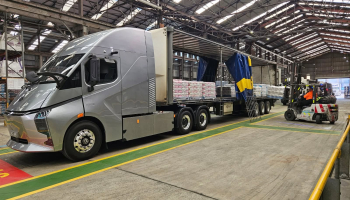 Deepway loading up. Photo curtesy Mark Blackburn.
“Have there been any enquiries from other trucking companies?” I asked. “Loads. We had 10 to 15 leads from the recent Megatrans show,” he enthused. He is about to do his fourth trip in the Deepway and expects the truck to continue to prove its worth. Any comments from the drivers? “We have one driver who hates me with a passion when I make him go back in the diesel.” The truck has been positively received by those who will need to “live” in it.
People who are interested in finding out more about Deepway in Australia or express an interest can contact Mark through his Deepway Australia website.
Not every diesel truck will be replaced tomorrow, but the fact is there are solutions available now for those logistics companies willing to take a step forward, not into the future so much as into the present. One less diesel delivery means more diesel for farmers and those sectors of the economy still waiting for the right electric tool for their job. VCF and Deepway are joining New Energy Transport, Centurion, Volvo, Windrose, and Janus providing tools that do less harm to the environment, and are good for the bank balance as well. Welcome to Australia Deepway, and congrats to VCF for real-world solutions.
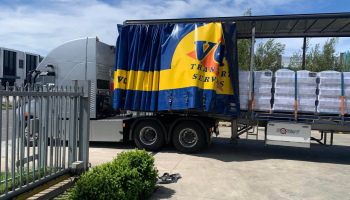 Photo courtesy Mark Blackburn.