 03:52

I haven’t covered a Tesla earnings release and call in a while, but I thought I’d give a quick summary since this quarter was pretty interesting. Last quarter I wrote this after the delivery release, but I didn’t write up the earnings call.
Observations From The Shareholder Deck:
- Gross margin way up, from 16.8% last quarter to 19.6%
- Operating margin almost doubled, from 1.4% to 2.6%
- Regulatory credits down from $146 million last quarter to $116 million, way down from $417 million a year ago or a peak of $542 million in Q4 2025
- Tesla announced it has the highest ever backlog for both passenger vehicles and energy storage
- Model Y capacity in Austin grew from >250,000 to >375,000 (annual)
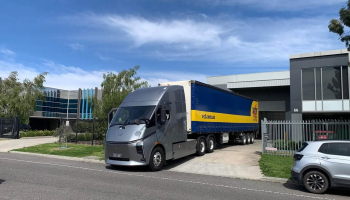
- Semi capacity went from commissioning to 25,000 (annual)
- California Optimus production went from construction to early ramp
- Cortex training compute went up a bit, from >205 MW to >225 MW, but the plan is to expand to 400 MW by the end of the year (that is not a change)
- No change in battery cell manufacturing capacity
- Texas Megapack capacity went from commissioning to 50 GWh (slightly bigger than the 40 GWh of California and Shanghai)
- FSD attach rate on new vehicles in North America jumped to 75%; active subscriptions up to 1.74 million from 1.48 million last quarter
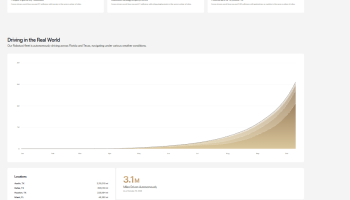
- Unsupervised Robotaxi miles were up dramatically from last quarter (looking at the graph) — up to about 1.7 million from 250,000. They also announced today they are up to 3.3 million miles!
- Published a new site to track a lot of information we have wanted for years!
Other highlights (AI generated):
- Revenue roughly flat at $28.05B (in line with consensus). Automotive revenue down ~3% YoY; Energy Generation & Storage revenue down ~16% to ~$2.9B (partly tariff-related customer refunds); Services & Other up sharply to ~$4.6B.
- GAAP net income $787M (down 43% YoY); non-GAAP net income ~$1.7B / $0.48 EPS (beat consensus). Includes mark-to-market swings on Bitcoin and SpaceX holdings.
- Surprise positive free cash flow of $1.53B (vs. expectations of a multi-billion-dollar burn). Capex came in at $4.73B, well below the ~$7–8B many expected.
- Full-year capex guidance cut to ~$20B (from the prior $25B+). Management said they are managing capital deployment more efficiently and plan to fund most of it from operating cash flow.
- Battery availability (not demand) was the limiter on auto volumes. They still ended the quarter with the largest passenger-vehicle backlog in four years and the highest-ever energy-storage order rate/backlog.
- Record quarterly deliveries in Canada, Australia, Japan, and Taiwan; record production at Gigafactory Berlin.
- Energy storage deployments 13.7 GWh (+10% YoY). First Megapacks built entirely with Tesla’s own Nevada LFP cells were shipped. Megafactory Texas is now in production (planned 50 GWh).
- Optimus: production has begun on high-volume lines in Fremont — “the first production-quality bots” suitable for a commercial product.
- Austin Fab (Terafab) construction continues; equipment commissioning planned for 2027.
Observations From The Call
- Production goal of 5 million vehicles a year by 2030 is new — unfortunately, last year the goal was a rate of 5 million vehicles a year by the end of 2028.
- Elon expects the Megapack business to expand in volume and margins as data center demand accelerates.
- Tesla hopes to roll out Unsupervised FSD to customer-owned vehicles in Q2 of next year (of course, the target has slipped MANY times).
- Tesla hopes to sell Cybercabs to others by the end of the year.
- Mapping overhaul: big AI-driven navigation/mapping improvements coming in the next few months; system learns both individual user and fleet preferences.
- Cybercab production is scaling quickly, and the company claims that it is easy to manufacture thanks to 50% fewer parts.
- It seems Cybercabs will be limited by regulations in the US and around the world.
- For years, the question we all had was: “is Tesla waiting to scale unsupervised because the software has to get better or for the regulators to approve it?” It seems they are happy with the quality of the software, but only in geofenced areas (opposite of the longtime promise that it wouldn’t be geofenced). This is annoying to existing owners, but won’t impact the ability of Tesla to scale to many cities and generate significant revenue.
- An analyst asked if the price of FSD would be forced down as other companies develop competitive software. Tesla executives claimed FSD is much tougher to develop than most people think. It is easy to develop a demo that works 90% of the time, but it is very difficult to solve all the edge cases.
Other highlights (AI generated):
- Elon: the biggest driver of vehicle demand right now is Full Self-Driving.
- Cybercab fleet in Austin has grown by a factor of ~10 since the September 3 launch. Next cities are being planned (Dallas mentioned as an early candidate). Robotaxi revenue expected to become noticeable in 2027 and more significant later that year.
- Unsupervised FSD for customer-owned vehicles targeted around Q2 2027 (Ashok). Cybercab customer availability more like 2027, but Elon emphasized it is primarily transport-as-a-service rather than a vehicle most people will own.
- Optimus: expect it will take roughly a year (maybe a bit more) to reach an annualized rate of ~1 million units (20,000/week). Initial customers will be industrial; outside customers more like end of 2027. Temper expectations — still a lot of reliability, wear, and AI work remaining.
- Hoping for broader EU FSD approval in the next few months or by Q1 (timeline not fully in Tesla’s control). Four new EU country approvals already since Q2; now live in nine EU countries, with >100,000 customers and >160 million km logged.
- Secured ~$30B of shorter-term debt capacity to help fund future capex if needed. Capex will ramp more meaningfully in 2027 and become “noticeable in the tens of billions” in 2028 (Optimus lines, AI compute, Cybercab, Terafab, etc.).
Conclusion
There are a lot of small pieces of good news. Tesla keeps promising vehicle growth, but every quarter they produce about the same number of cars. This seemed to be the first call where they are quickly scaling Robotaxi instead of promising to do that in the future. It seemed to coincide with the Cybercab launch last month. Since the Model Y has the same computer and cameras, many people (including me) thought they would scale the Model Y Robotaxi service first, then bring in the Cybercabs. It appears the software got good at about the same time as Cybercab production got going. I guess a happy coincidence.
On traditional car sales, they clearly have huge demand (which is very different than other automakers of battery electric vehicles in the US), which is because of both FSD and high oil prices causes by both the Iran and Ukraine war. They claim to be increasing production in Austin and Berlin, but it doesn’t seem to be enough to reduce the backlog. Tesla could sell a lot more cars if they had some inventory. Many people can’t wait a long time to get a new car, since they are typically buying because of the end of lease, an accident, or a breakdown of an existing car. Those people have to buy a used Tesla (which is why this page shows CarMax selling a 2026 Model Y with 6,000 miles for $4,000 more than a new 2027 Model!). You can get more details here on the CarMax site.
If you want to take advantage of my Tesla referral link to get up three months Full Self Driving, here’s the link: https://ts.la/paul92237 — but if another owner helped you more, please use their link instead of mine.
Disclosure: I am a shareholder in Tesla [TSLA] and XPeng [XPEV]. But I offer no investment advice of any sort here.