 18:52


In September, the Canadian government published its Changing Climate Report 2026 (CCCR). Unlike its southern neighbor, Canada believes its citizens have the ability to understand scientific studies and form their own opinions about how their government should respond. Here is Headline 12 from that report:
Iconic landscapes are changing across Canada as snow and ice disappear. Glaciers in western Canada will largely disappear by the end of this century. Warming temperatures have shortened the snow cover season and reduced sea ice cover of all types. Permafrost thaw is transforming the land in many places across northern Canada. These changes will intensify with additional warming.
The report is the result of three years of hard work by Canadian scientists and other contriubutors. One of their conclusions is that the northernmost regions of the country, particularly those in the Arctic, will warm much faster than the rest of the country. We have heard of this phenomenon recently in Norway, where the town of Longyearbyen, the northernmost settlement in the world, is suffering from the consequences of melting permafrost.
Don’t Look Now
The good news is that Canada is continuing to issue reports on climate changes that will affect the country. The US government is petrified about telling its citizens the truth. In Florida, governor Snarling Ron DeathSentence has prohibited any state or local agency from uttering the hated words “climate change,” as if doing so will magically keep hurricanes from forming and sea levels from rising.
But there is some less than happy news this year. The first Canadian Changing Climate Report was issued in 2019 to much fanfare at a national press conference. This year, the report was issued quietly in a simple press release on the eve of a long holiday weekend. Climate hushing is apparently the new modus operandi of the Canadian government, which undercuts the reason for the three years of painstaking research in the first place. A diligent search of the interwebs using the latest version of an Apple Macintosh computer in the CleanTechnica first sub-basement found virtually no press reports about the CCCR.
Only CTV News bothered to cover the report. It said the scientists who contributed to the paper were genuinely concerned by the lack of publicity given to it. Requests to interview Julie Dabrusin, the federal minister for Environment, Climate Change, and Nature, were declined. A statement from her office to CTV News said only,“Our government is moving with urgency to fight climate change, while working together to build the energy security, industrial capacity, and strategic autonomy that will define this century for Canada.”
Environment and Climate Change Canada
The report was prepared by Environment and Climate Change Canada (ECCC), which brings together the efforts of nearly 100 scientists. Its 2026 report is almost 1,500 pages long and highlights multiple trends that should be of concern to Canadians. Warming temperatures are driving a wide range of “interconnected, and sustained changes across Canada,” the report said, adding that “the warming and associated changes in climate in Canada are effectively irreversible.”
“Canadians need to prepare themselves for the fact that by the end of this century, most of the glaciers in western Canada will be gone,”said Chris Derksen, the director of modeling for the ECCC. “That’s an important water supply. it flows from west to east across the country.”
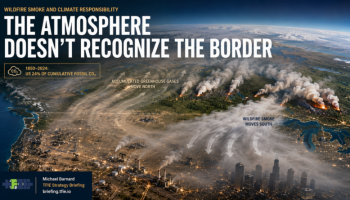
He added that, “If we continue on a path towards more warming, we should expect the size of the forest fires in Canada to increase. If we get a handle on warming, then we can decrease the size of forest fires and the severity of weather events across the country.”
Moving Goal Posts
In June, Prime Minister Mark Carney admitted that Canada will not meet its 2030 greenhouse-gas emissions targets, and announced the deadline was being extended to 2050. How that squares with Dabrusin’s claim that the government is “moving with urgency to fight climate change” is unclear. It sounds like kicking the can down the road to us.
We know Carney is paddling furiously upstream to counter the venom and bile being directed at Canada by the so-called president of the United States and his hate filled minions, but ignoring the problem will not make it go away. Once again, short term interests are being allowed to override long term concerns.
Damon Matthews, a professor and climate scientist at Concordia University in Montreal, and one off the reports many co-authors, told CTV News that Ottawa and global policy makers simply aren’t doing enough to save the plant from climate catastrophes. “The current policies we have globally and here in Canada are not consistent with meeting that temperature target. As a result, right now, we’re looking at more intense climate events and damaging storms on the horizon.”
Flooding And Drought
One of the many findings of the report was this: “Droughts and flash floods will become more frequent and severe with additional warming. Summer droughts are projected to become longer and more intense and occur more frequently in central and southern Canada. Increases in the frequency and intensity of atmospheric rivers (in high emissions scenarios) and of extreme rainfall will lead to more frequent and intense flash flooding.”
The CCCR warns that if there are no global policies in place to address how the planet is overheating, we should expect warming to increase by 3.8º C, which would be intolerable to humans and most plants and animals. In that scenario, the area of the country at risk of forest fires would triple, while under a net zero strategy, warming would stabilize after 2050 and reach “only” 1.95º C.
The CCCR 2026 report makes it unmistakably clear that global heating is primarily a result burning coal, oil and gas, although the hot air coming from the vicinity of Washington, DC may be a contributing factor.